Copyright and Handling AI-Generated Work
On this page12 items
In 10 seconds
This page covers only general principles and a way of organizing your thinking. It does not judge individual cases.
This area keeps changing, so before you publish, check the current practice in that field.
If you created a work in Chapter 10, or made materials in Chapter 8, read this before putting anything out into the world.
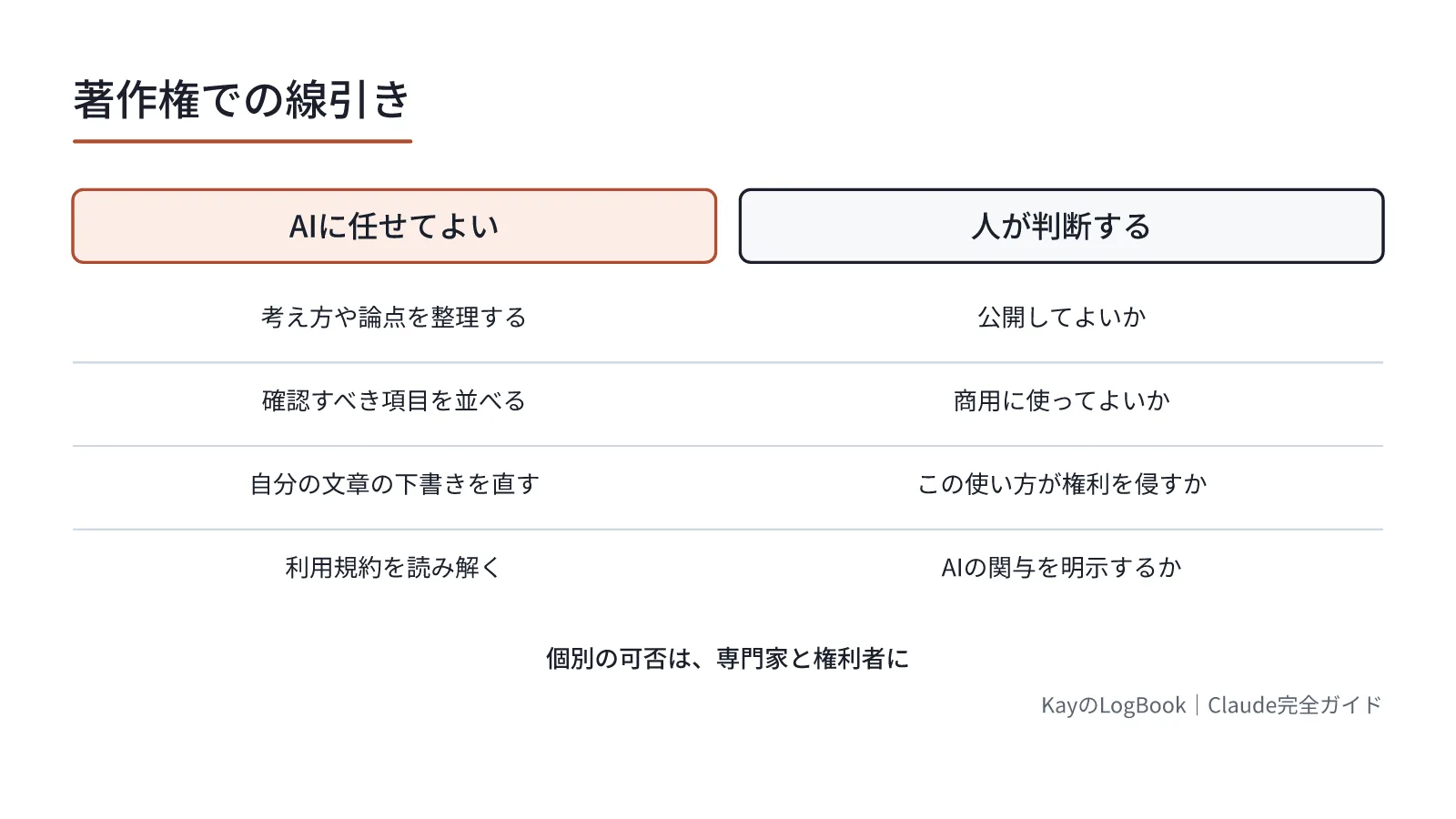
First, what this page does not cover#
- Whether you may publish it
- Whether you may use it commercially
- Whether a given use infringes anyone’s rights
- Whether you should disclose AI involvement
There are three reasons. Legal systems differ by country. Practices differ by field. And all of it keeps changing right now.
Don’t use anything written on this page as the basis for a decision.
Where the line is#
Think in three situations#
Rights questions get confusing because separate problems get mixed together. Let’s split them.
1. When you give it. May you have Claude read someone else’s copyrighted work?
2. When it comes out. What happens to the rights in the generated output?
3. When you release it. May you present, publish or sell it?
Each raises different issues.
When you give it#
Text someone else wrote, another company’s materials, assets you purchased. How should you think about having Claude read them in the first place?
What you need to check is the terms of use for that work.
- Does a contract or terms of service restrict providing it to third-party services?
- Is it marked confidential?
- If it’s from an asset library, is this within the permitted scope of use?
I suspect many contracts still don’t anticipate having an AI read the material. Just because it isn’t written down doesn’t mean you’re free to do it. If in doubt, check with the rights holder or your legal department.
And, as in Chapter 8, #62, don’t ask Claude “Is this OK under copyright law?” Plausible-sounding falsehoods creep into both statutes and case law (#80).
When it comes out#
How generated output may be used is determined by the provider’s terms. Anthropic’s Commercial Terms of Service are the primary source.
However, what the terms allow and what is free of rights issues are two different things. For example, if the output ends up resembling an existing work, that’s a separate problem from the terms.
In practice, take two stances.
Check that it isn’t similar to something. Be especially careful with “short, distinctive things” like taglines, characters and melodies. Search and check.
Use it as a draft. Something you’ve rewritten with your own hands is easier to treat as your own. Chapter 10, #72’s advice to “write the middle yourself” pays off in this sense too.
When you release it#
This is where practices differ most between fields.
- Fields that require disclosure (academia, journalism, open calls, some platforms)
- Fields where practice hasn’t settled
- Fields where not disclosing is normal (internal documents, personal notes)
Read the terms of where you’re submitting. More and more of them mention AI use. Open calls and contests often state it explicitly in the submission guidelines.
And even if nothing is written, there’s something to consider: will readers assume a human wrote it? If there’s a gap there, it’s more honest to tell them.
In the case of this guide#
This guide states from the very start that it was made with Claude Code (#60, #83).
There are two reasons. That process is itself a subject of the guide, and it would make no sense for a guide about AI to hide AI’s involvement.
This is one judgment call, not the right answer. It varies with the field and the readers.
It keeps changing#
Here is the most important sentence on this page.
This area is changing right now. Legal systems, case law, platform terms, field practices — all of them.
So “I looked it up before, so it’s fine” doesn’t hold.
Before a major release or commercial use, check the situation as it stands at that time. Check the terms of where you’re publishing, guidelines from industry bodies, and, if needed, experts.
Try it: list what you need to check (5 minutes)
If you have a work or material you’re thinking of publishing, use that.
Prompt
“`
I’m thinking of publishing (what I made) on (where).List the items I should check before publishing.
・About the terms of use for the materials I provided
・About the terms of use for the generated output
・About the terms of the place I’m publishing
・About gaps in what readers will assumeDon’t cite names of laws or article numbers.
Don’t judge whether it’s allowed either. Just the items to check, please.
“`Expected result: check items lined up under the four perspectives. Some you hadn’t thought of will be mixed in.
If it doesn’t work: if it gives a definitive yes or no, the instruction didn’t take. The point of this page is to get check items, not judgments.
Common pitfalls#
Asking Claude whether something is legally allowed. Plausible falsehoods creep into both statutes and case law.
Stopping at “the terms allow it.” If the output resembles an existing work, that’s a separate problem.
Relying on what you looked up before. It keeps changing.
Not reading the terms of where you’re publishing. More of them mention AI.
Related pages#
- #72 Writing and Ideas — write the middle yourself
- #78 Security and Privacy — what you may hand over
- #80 Working with Claude on the Assumption It Makes Mistakes — about invented statutes
Summary#
- This page covers only general principles and a way of organizing your thinking. Individual yes-or-no questions go to experts and rights holders
- Think separately about when you give it, when it comes out, and when you release it
- What the terms allow and what is free of rights issues are two different things
- It keeps changing. Before releasing, check the situation as it stands at that time