Procedures, Paperwork, and Manuals
On this page12 items
In 10 seconds
What it’s good for is general research and drafting, and no further.
Before you submit anything, always confirm it yourself against primary sources. Procedures differ by municipality and by product.
First, what this page doesn’t cover#
- Judging whether what you submit is correct
- Judging whether something applies to your case
- Stating deadlines or requirements definitively
The reason is simple: procedures differ by municipality, insurance by product, and contracts by property. Something can be true in general and still not apply to your case.
Where to draw the line#
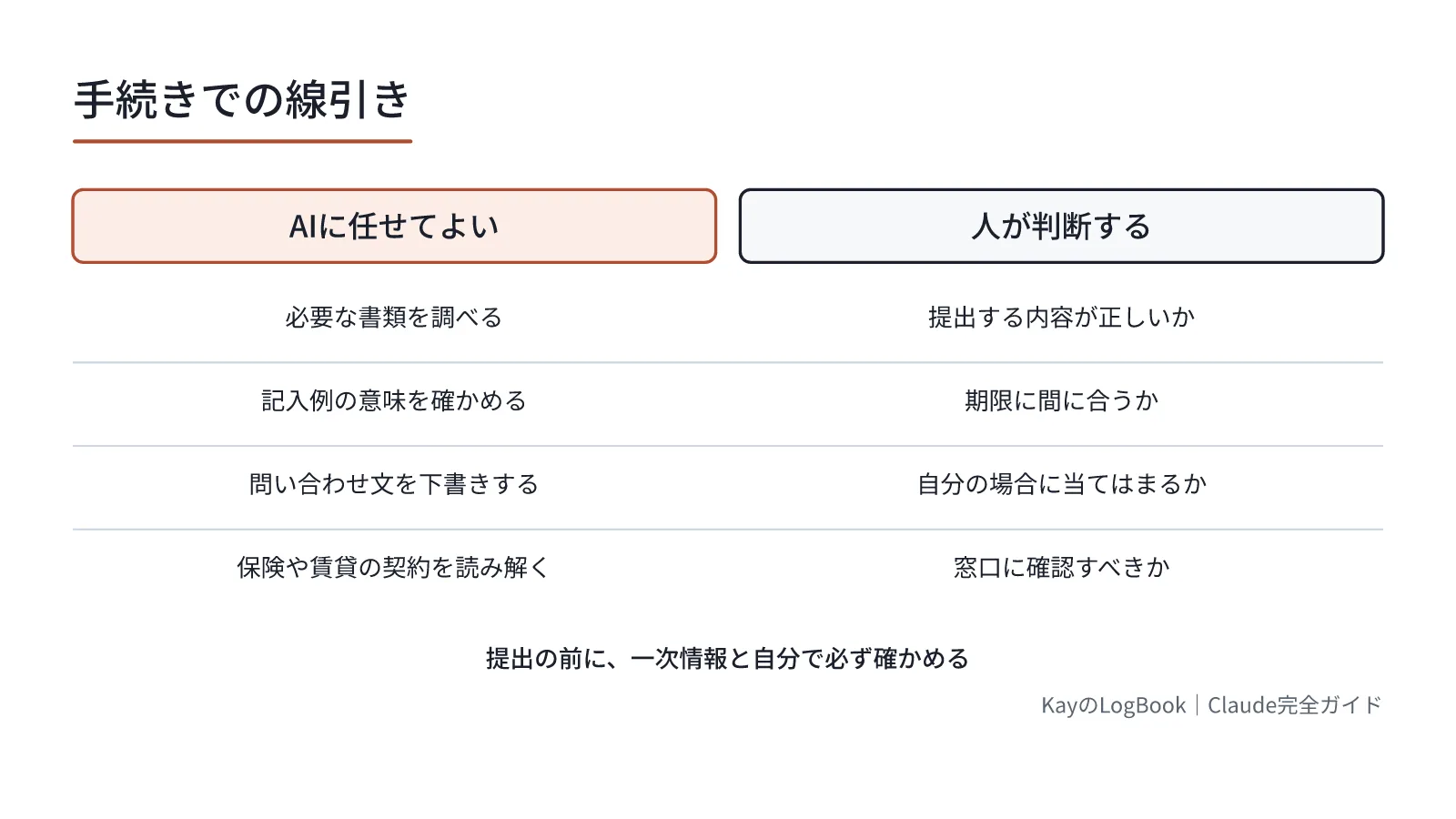
Researching government procedures#
It goes as far as getting a sense of what you’ll need.
Please tell me about (name of procedure).

- Documents generally required
- The general flow
- Common stumbling points
- Parts likely to differ by municipality

**Don't state specific deadlines, amounts, or conditions definitively.**
I'll check on the municipality's official website. Please list the items I should check.
Asking it to list the items you should check is the request that comes up most on this page. Claude is the guide; the answers are on the official website.
Having a list before you go to the counter saves you from having to come back because a document was missing.
Reading insurance and rental contracts#
Same stance as Chapter 8, No.62, applied to personal contracts.
Please tell me about this contract.

- My obligations and the other party's obligations
- Conditions under which money changes hands (when, how much, in what cases)
- Conditions for cancellation and renewal, and the costs involved
- Vague wording that could be interpreted in different ways

Don't cite names of laws or article numbers.
Quote the relevant passages from the original text verbatim.
Not letting it cite article numbers matters because they’re a classic example of plausible-sounding falsehoods creeping in (No.02, No.80).
For insurance, it’s practical to ask about the conditions under which it won’t pay first.
Under what circumstances does this insurance not pay out?
Please explain while quoting the original text of the contract.
The cases where it doesn’t pay are what cause trouble later, more than the cases where it does.
For any remaining questions, ask the provider’s customer service. That’s your primary source.
Manuals for appliances and devices#
This is the most casual use case.
Here are photos of the manual. Please tell me:

- The settings I should configure first, in order
- Common mistakes people make
- If there are parts you can't read from the photos, say so
Pulling only the parts you need from a thick manual also works well.
I'm attaching the manual for (model name).
Extract only the steps for (what you want to do), with page numbers.
With older model numbers, Claude may not know about them. In that case, hand over the manual as a PDF or photos (No.17).
Drafting inquiries#
This is for writing messages that are hard to write.
I'm contacting (recipient). Please write a draft.

- What I want to convey: (situation)
- What I want to ask: (question)
- My position: (policyholder, user, etc.)
- Don't get emotional; facts first, questions clear

Don't add anything I haven't stated as fact.
The last line is important. Send it with added “facts” left in, and things get messy.
With complaints or cancellations, once emotion gets in, the main point doesn’t get across. Having it write a draft and then adjusting the temperature yourself works just right.
Things with deadlines#
Procedures have deadlines. Don’t ask Claude for the deadline.
For this procedure, list the things that have deadlines.
Don't give specific dates; tell me "where to look to find out."
Converting the question to where to look to find out is the pattern for this entire page.
Try it: Have it list the items to check (5 min)
Pick a procedure you’re about to do.
Prompt
“`
Please tell me about (name of procedure).
- Documents generally required
- The general flow
- Common stumbling points
- Parts likely to differ by municipality (or company)
Don’t state specific deadlines, amounts, or conditions definitively.
I’ll check on the official website. Please list the items I should check.
“`Expected result: You get the general flow and a checklist, separately. The “parts that differ by municipality” include items you hadn’t anticipated.
If it doesn’t work: If specific amounts or deadlines are stated definitively, the instruction isn’t taking effect. Knowing that it behaves this way is valuable in itself.
Common pitfalls#
Trusting deadlines and amounts. Check on the official website.
Letting it cite article numbers. Plausible-sounding falsehoods creep in.
Assuming your case is the same. General rules are just general rules.
Getting facts added to your draft. Include “Don’t add anything” every time.
Related pages#
- No.62 Preparing contracts and legal work — Business contracts
- No.68 Organizing household finances — Insurance and rental costs
- No.80 Working with AI on the assumption it makes mistakes — On articles that don’t exist
Where to go from here#
That’s the end of Chapter 9. You now have practical examples for the full range of daily-life situations.
- Daily-life route → Chapter 11 Security and privacy (No.78)
Chapter 11 covers what’s fine to hand over and what’s better not to, and how to deal with mistakes. It ties together all the “please confirm” notes from each page so far.
Summary#
- It’s good for general research and drafts, and no further
- Don’t let it state deadlines, amounts, or conditions definitively. Convert to “where to look to find out”
- For contracts, don’t let it cite article numbers; have it quote the original text
- For inquiries, always include “don’t add facts”