Organizing Household Finances
On this page10 items
In 10 seconds
AI lines up the numbers; you make the decisions.
From organizing your budget to finding angles for reviewing fixed costs and reading documents. Always calculate amounts with code.
Drawing the line#
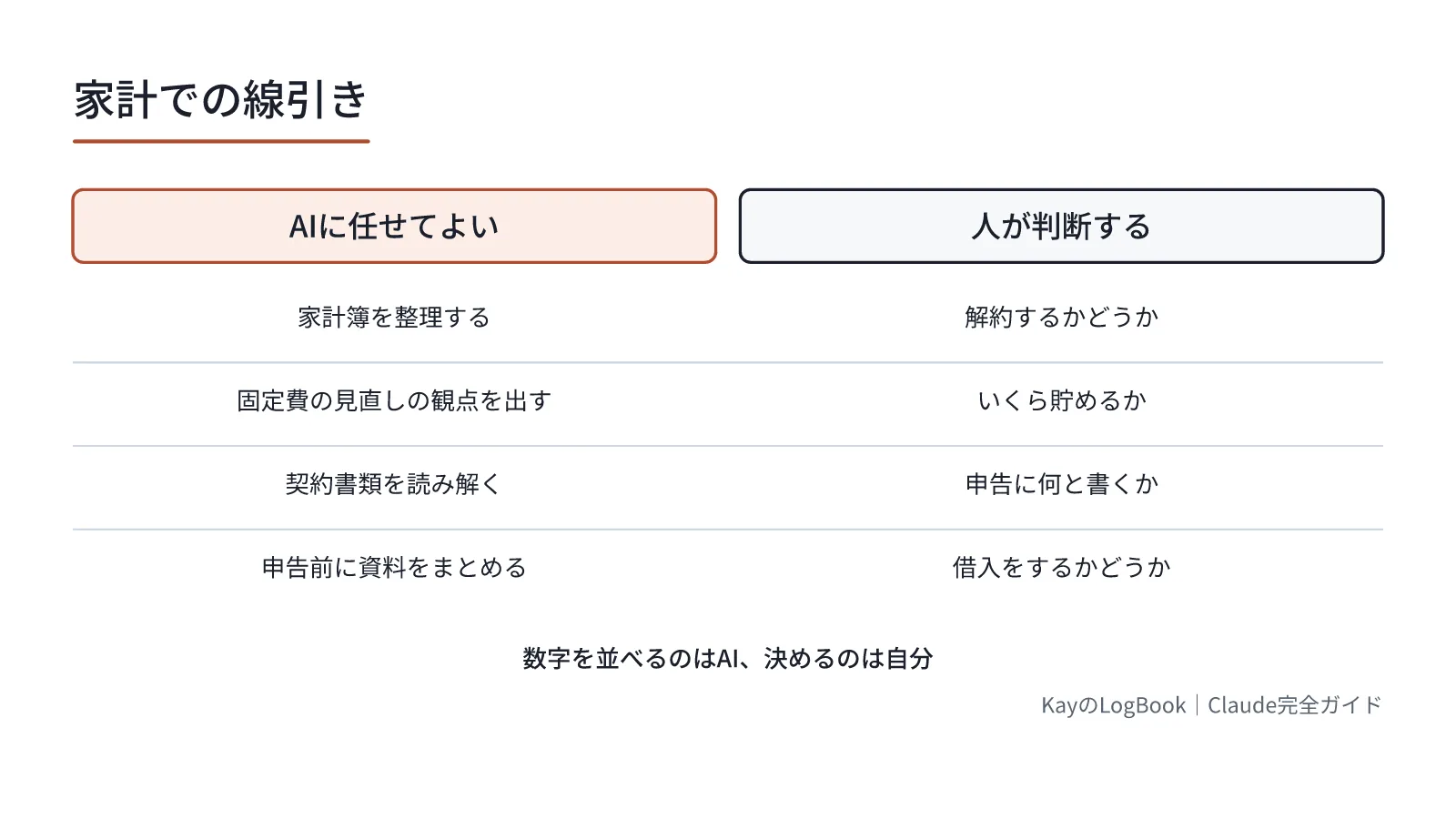
What this page doesn’t cover:
- Deciding whether to cancel something
- Deciding how much you should save
- Deciding whether to take out a loan
- Deciding what to write on your tax return
For the last one, the business case is covered in Chapter 8, No.63. The same goes for individuals: it handles organizing materials and nothing more. Don’t let it calculate tax amounts or make definitive statements about what to file. The primary source is the National Tax Agency, and judgment belongs with professionals such as tax accountants.
Organizing your household budget#
Handing over a CSV of your statements is the fastest way.
Attached is a year of credit card statements. Produce the following:

・Monthly totals by expense category
・Items that are roughly the same each month (fixed-cost candidates) vs. items that vary month to month
・Categories whose trend changed between last year and this year
・Do the calculations with code; don't count by eye
・Check that the number of rows matches the number of transactions in the statement
Include calculating with code and matching the count every time (No.59). Since this is about money, it matters especially here.
The category assignments may not match your own sense of things. When that happens, hand over your classification criteria again and they’ll line up.
Reviewing fixed costs#
Having it come up with angles to check is the heart of this page (the same pattern as No.65).
I'm reviewing my fixed costs. For the following contracts, list the points I should check.

・(list of contracts: phone/internet, insurance, subscriptions, etc.)

・For each, "where to look to spot waste"
・Things that will cost me if I overlook them when canceling or changing
・Separate what has an immediate effect from what takes time

Don't decide whether I should cancel anything.
Having it separate out what has an immediate effect makes it easier to get started.
For the amounts themselves, look at the contract or the billing statement. If you ask Claude, you’ll get outdated prices (No.65).
Reading contract documents#
Insurance, rentals, loans. This is about contracts that individuals read. Treat them with the same attitude as the legal work in Chapter 8, No.62.
Tell me about this contract.

・The obligations I take on and the obligations the other party takes on
・Conditions under which money changes hands (when, how much, in what cases)
・Conditions for cancellation and renewal, and the costs involved
・Ambiguous wording that could be interpreted in different ways

Don't cite names of laws or article numbers.
Quote the relevant passages verbatim from the original.
Not letting it cite article numbers is for the same reason as No.62. It’s a prime example of where plausible falsehoods creep in (No.02, No.80).
If anything remains unclear, ask the other party’s customer service. That’s the primary source.
Preparing for your tax return#
Only as far as gathering the materials.
I'm preparing my tax return. Organize the materials I have.

・A list of receipts (date, payee, amount, description)
・Always total the amounts with code
・Leave anything unreadable blank and report which file it was
・Put anything with an ambiguous category into a separate "needs checking" group

Don't decide whether something counts as a deductible expense.
Also don't deal with what to write on the return.
The last two lines draw the line. They match No.63.
The rules change every year. Check which tax year applies and consult the primary information from the National Tax Agency.
Before handing it over#
Household statements contain a complete record of where you bought what.
As noted in Chapter 4, No.27, the official safety guide explicitly says not to grant access to financial documents and personal records.
The realistic approach is to hand over a copy with only the columns you need, after preprocessing such as hiding store names and removing account numbers. This is covered in detail in Chapter 11, No.78.
Try it: have it come up with angles for reviewing fixed costs (5 minutes)
Write down as many of your contracts as you can remember. You don’t need to include amounts.
Prompt
“`
I’m reviewing my fixed costs. For the following contracts, list the points I should check.・(list of contracts)
・For each, “where to look to spot waste”
・Things that will cost me if I overlook them when canceling or changing
・Separate what has an immediate effect from what takes timeDon’t decide whether I should cancel anything.
“`Expected result: Check points appear for each contract, split into two groups. Items you didn’t know about show up among “things that will cost me if I overlook them.”
If it doesn’t work: If you only get generic advice, describe the types of contracts a bit more specifically.
Common pitfalls#
Having it total amounts by eye. Always use code.
Asking about prices. You’ll get outdated numbers. Look at the contract or statement.
Having it decide whether something is a deductible expense. It depends on individual circumstances (No.63).
Handing over statements as is. Include only the columns you need.
Related pages#
- No.59 Data Analysis and Reports — don’t let it count by eye
- No.63 Accounting, Tax and Back Office — for businesses
- No.69 Learning About Investing and Money — on managing assets
- No.78 Security and Privacy — deciding whether to hand over statements
Summary#
- AI lines up the numbers; you make the decisions
- For fixed costs, have it come up with angles to check. Get amounts from contracts or statements
- For contracts, don’t let it cite article numbers; have it quote the original
- For tax returns, only as far as organizing materials. Leave judgment to professionals