Dividing Roles Like a Team at Work
On this page7 items
In 10 seconds
Working with agents follows the same pattern as handing work to a person.
There is just one difference. An agent doesn’t share your history, so you have to provide the background every time.
Talk about agents tends to get abstract. This page reframes it as the way you hand off work at a company. The metaphor is used again from Chapter 5 onward.
Three roles#
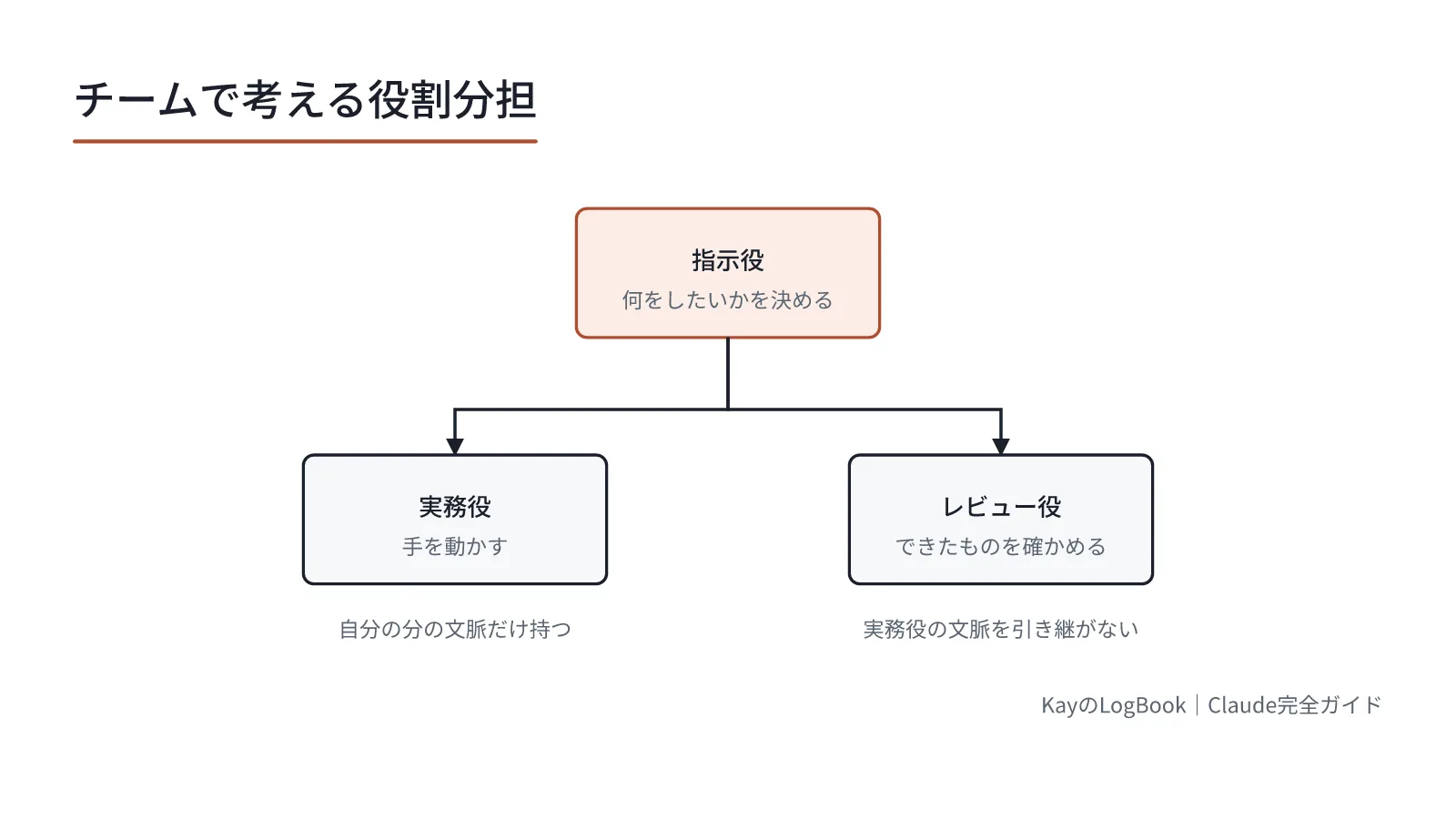
The director is a person. The director decides what needs to be done and receives the finished result. This is the one role that cannot be handed off.
The worker does the hands-on work. Opening PDFs, extracting fields, building tables. This is the part an agent takes on.
The reviewer checks. Is the row count right? Do the numbers add up? The key is to make this someone other than the worker. Grading your own work leads to lenient grades, for people and AI alike.
For small jobs, it’s fine to let the worker double as the reviewer. The more important the job, the more you should separate them. This judgment leads directly into subagents in Chapter 5.
How it differs from asking a person#
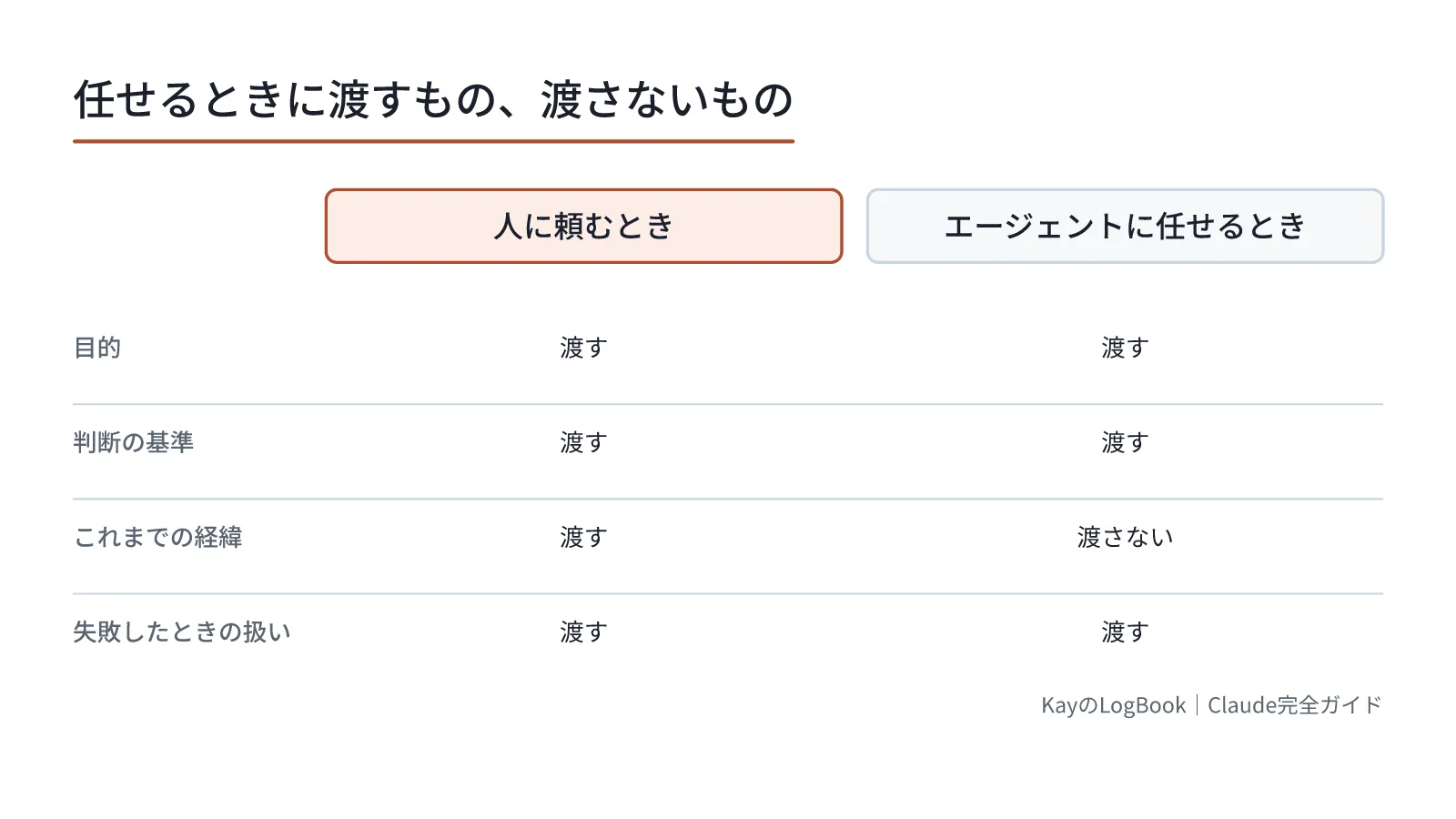
When you ask a person for something, you leave a lot unsaid. “Can you pull together that quote thing?” works because the other person knows the history.
An agent has none of that. It doesn’t have the content of previous conversations, last week’s decisions, or the internal circumstances of your company. So everything you leave out gets filled in by guesswork.
What you need to hand over is the same as with a person: the goal, the criteria for judgment, and what to do when something fails. The only difference is that the “background” you can skip with a person has to be put into words for an agent.
This is a bit of a hassle, but it has a side benefit: putting things into words reveals what was vague even to you. For example, you start to write “pick the cheaper one” and realize you never decided whether that means total cost or unit price.
A bad request and a good request#
A bad request.
Look through the quotes folder and sum it up nicely.That would be hard for a person to follow, too. There’s no shared understanding of what “nicely” means.
A good request.
From the PDFs for the 5 vendors in the quotes folder, extract the product name,
quantity, unit price and delivery date into a single table.

- Unit price as a number only. Delivery date in YYYY-MM-DD format
- Leave any field you can't read blank, and report which file and where
- Show me the table once it's done. Don't save it yet
The last line is what protects the director’s role. This is where “the point at which to stop,” covered in #19, comes in.
Responsibility doesn’t transfer#
There is one caveat with this metaphor. When you hand work to a person, part of the responsibility moves to them, but when you hand work to an agent, none of it does.
If the resulting table is wrong, “Claude made a mistake” is not an excuse. It was the director who failed to design a checking step.
So when you widen the scope of what you delegate, you need to widen the checking mechanisms along with it. Widen only one, and things quietly break.
Try it: Split your own work into the three roles (5 minutes)
Prompt
“`
Break down my work into three roles: director, worker and reviewer.
For each one, decide whether it can be handed to AI or should stay with a person,
and explain why.Work: (describe one task you do every week, including the steps)
“`Expected result: The work splits into three roles, with the director staying with a person. Opinions differ on how to handle the reviewer.
If it doesn’t work: If even the reviewer comes back as “can be handed to AI,” ask again and add “the impact if a mistake goes unnoticed.” The bigger the impact, the more the verdict shifts toward a person keeping it.
Common pitfalls#
Having the worker and the reviewer in the same place. Ask the one who made something “Is this correct?” and it will usually say yes. Check in a separate conversation, with a separate agent, and the accuracy changes.
Giving up the director’s role. Asking “What do you think I should do?” is useful as a consultation, but the decision belongs to a person. While you feel you’ve delegated, you can end up in a state where nobody has decided anything.
Not keeping requests that worked. Good instructions are an asset. Rewriting them from scratch the next time you do the same job is a waste. How to save and reuse them is covered in #25.
Summary#
- There are three roles: director, worker and reviewer. Only the director cannot be handed off
- The difference from a person is that an agent doesn’t share your history. Whatever you leave out gets filled in by guesswork
- Separate the worker and the reviewer. Self-grading is lenient
- Delegating doesn’t transfer responsibility. If you widen the scope, widen the checks too