Personal Projects: From Zero to Launch
On this page13 items
In 10 seconds
Building things has definitely gotten faster than before.
The hard part is keeping it going after launch. That hasn’t changed.
This is the final page of Chapter 10. It ties the previous pages together and walks through everything from zero to launch.
The overall shape#
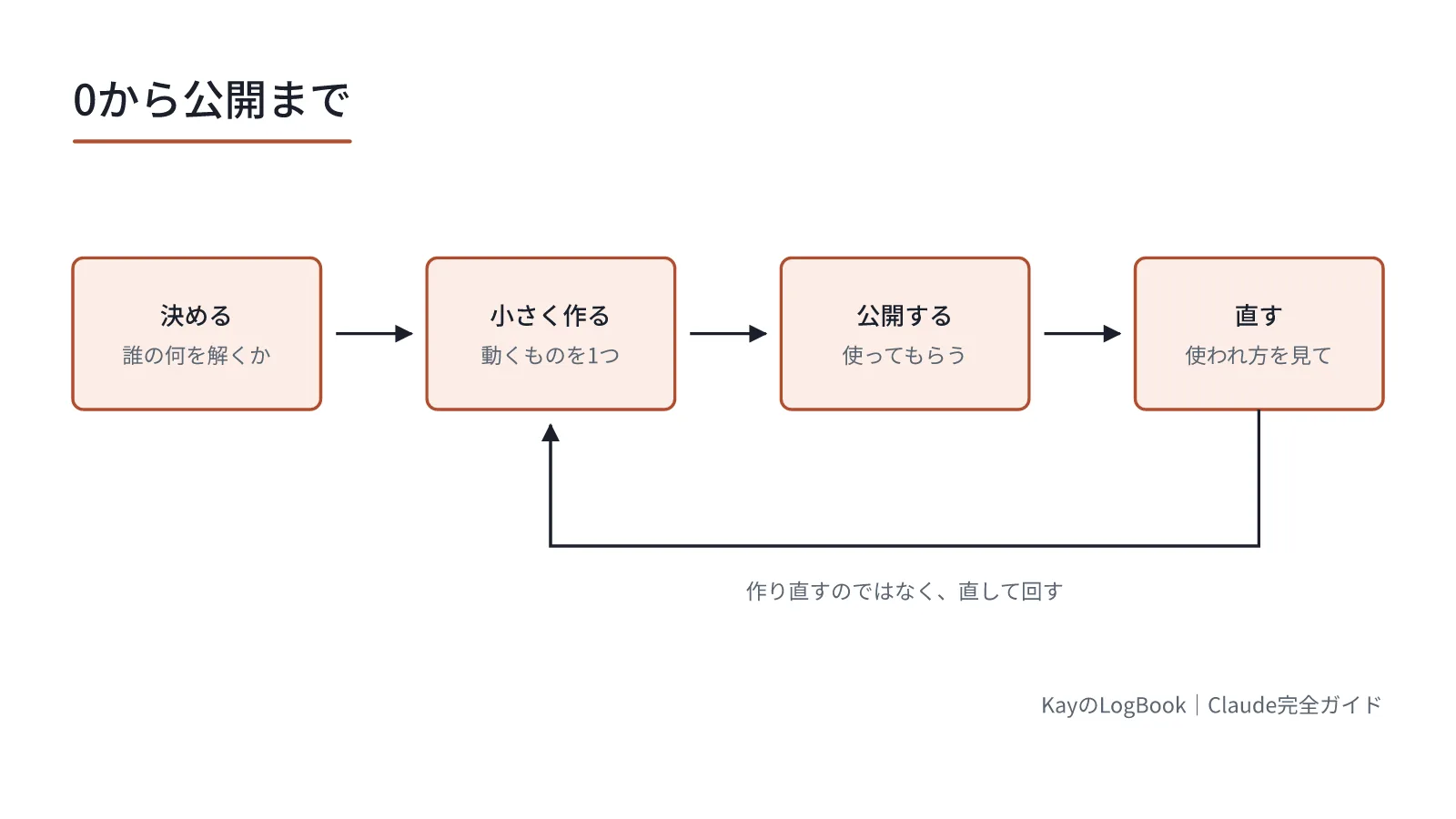
Decide → build small → launch → fix. Then go around again.
The most common failure is spending too long deciding and never reaching launch.
Decide#
Decide for yourself what to build (Chapter 3, No.22). That said, having Claude inspect what you’ve decided is effective.
I'm thinking of building (what you want to build).

・Read my explanation and rewrite it as: who it's for, in what situation, and what it solves
・Three parts of that explanation that are vague
・Three features you think "might not be needed"
・One minimal form that still delivers value

I don't need agreement.

(write your idea)
The first item pays off. When your explanation comes back in someone else’s words, you can see the parts that aren’t getting across.
Having it list three things that might not be needed is also important. In personal projects, the decision to cut is the hardest.
Build small#
This is exactly the pattern from Chapter 5 (No.37): research → plan → implement → verify.
What works especially well for personal projects is writing CLAUDE.md first (No.38).
Create a CLAUDE.md for this project.

・What we're building (one paragraph)
・The definition of done
・Things we've deliberately decided not to do
・The technologies used and why they were chosen

Don't write anything that can be read from the code.
Don't write any code yet.
Writing down what you’ve decided not to do at the start lets you pause when you’re tempted to add features midway.
And commit before working (No.39). There are paths you can’t roll back.
Launch#
Many people stop here. The reason is usually because it isn’t finished yet.
It will never be finished. Launching and then fixing is faster, and it shows you what needs fixing.
There are only three things to do before launch.
Make sure it works. Once, somewhere other than your own environment.
Make sure you’ll notice when it breaks. Do errors reach you? If not, it will break silently (Chapter 7, No.55).
If you handle personal data, decide how. What you store, where you keep it, and who can see it. Read No.78 in Chapter 11 before launching.
If you use the API#
If you put Claude into your own service, designing costs becomes designing the business (Chapter 7, No.53, No.55).
- A mechanism that stops one person from using too much
- A spending cap
- Usage records
The scariest thing in a personal project is a bill several times what you expected. Set a cap before launching.
Fix and iterate#
Here is what to do after launch.
Organize the feedback collected since launch.

・Separate actual pain points from feature requests
・Group multiple pieces of feedback that say the same thing
・Point out any ways it's being used that I didn't anticipate
・Don't prioritize. I'll decide

(paste the collected feedback)
Ways of using it that you didn’t anticipate are the most valuable information.
Systems for keeping it going#
What’s really hard about personal projects is keeping them going. Not the technology.
What has worked:
Write down what to do next on the same day. Leave it for a week and you’ll forget what you were doing. At the end of a session, have it write the next step.
Summarize what we did today and what to do next.
・Only one next step. Be specific
・Include the files to refer to at that point
・Write it to NEXT.md
The trick is to write it before you let go. When you open it next time, you can start without hesitation.
Regularly check that it isn’t broken. Services that are in use break if left alone. Turn the checks into a system (Chapter 5, No.43).
This guide was made the same way#
This 87-page guide was made with the same shape as a personal project.
Decide (fix the structure first) → build small (Chapter 1, one page at a time) → launch (chapter by chapter) → fix (changed the structure after people read it).
In fact, I changed the structure after publishing Chapter 1. I added summaries at the top and removed duplicated sections. The rework was limited to 11 pages because I published early.
Had I aimed for perfection first, it would have meant 84 pages of rework.
Try it: have it decide what to cut (5 minutes)
If you have something you want to build, use that.
Prompt
“`
I’m thinking of building (what you want to build).・Read my explanation and rewrite it as: who it’s for, in what situation,
and what it solves
・Three parts of that explanation that are vague
・Three features you think “might not be needed”
・One minimal form that still delivers valueI don’t need agreement.
(write your idea)
“`Expected result: your explanation comes back in someone else’s words, along with three candidates to cut. The candidates to cut sometimes include the feature you most wanted to build.
If it doesn’t work: if no candidates to cut come out, emphasize “the minimal form that can be launched.”
Common pitfalls#
Trying to finish before launching. It will never be finished.
Not setting a cost cap. You may be billed several times what you expected.
Closing without writing what to do next. After a week away, you won’t be able to pick it back up.
Launching without deciding how to handle personal data. Read No.78.
Where to go from here#
This is the end of the main creative track. If you’ve read Chapter 1 → Chapter 2 → Chapter 3 → Chapter 10, you’ve gone all the way through using Claude, delegating to it and making things with it.
From here, there are two ways forward.
- If you’ll launch and operate something → Chapter 11, Security and privacy (No.78). And be sure to read No.79 Copyright and handling generated content before publishing your work
- If you’ll extend it to your job → start with Chapter 8, Office work, planning and meeting notes (No.56)
Chapters 8 and 9 are collections of practical uses, so feel free to open whichever page interests you.
Related pages#
- No.38 CLAUDE.md and memory — the project’s constitution
- No.55 Building it into your own app — designing for operations
- No.79 Copyright and handling generated content — before you publish
- No.83 How this guide was made — a record of the production
Summary#
- Building has gotten faster. The hard part is keeping it going after launch
- The decision to cut is the hardest. Have it list features you don’t need
- Don’t wait until it’s finished to launch. Fixing and iterating is faster
- Write what to do next before you let go