Learning About Investing and Money
On this page12 items
In 10 seconds
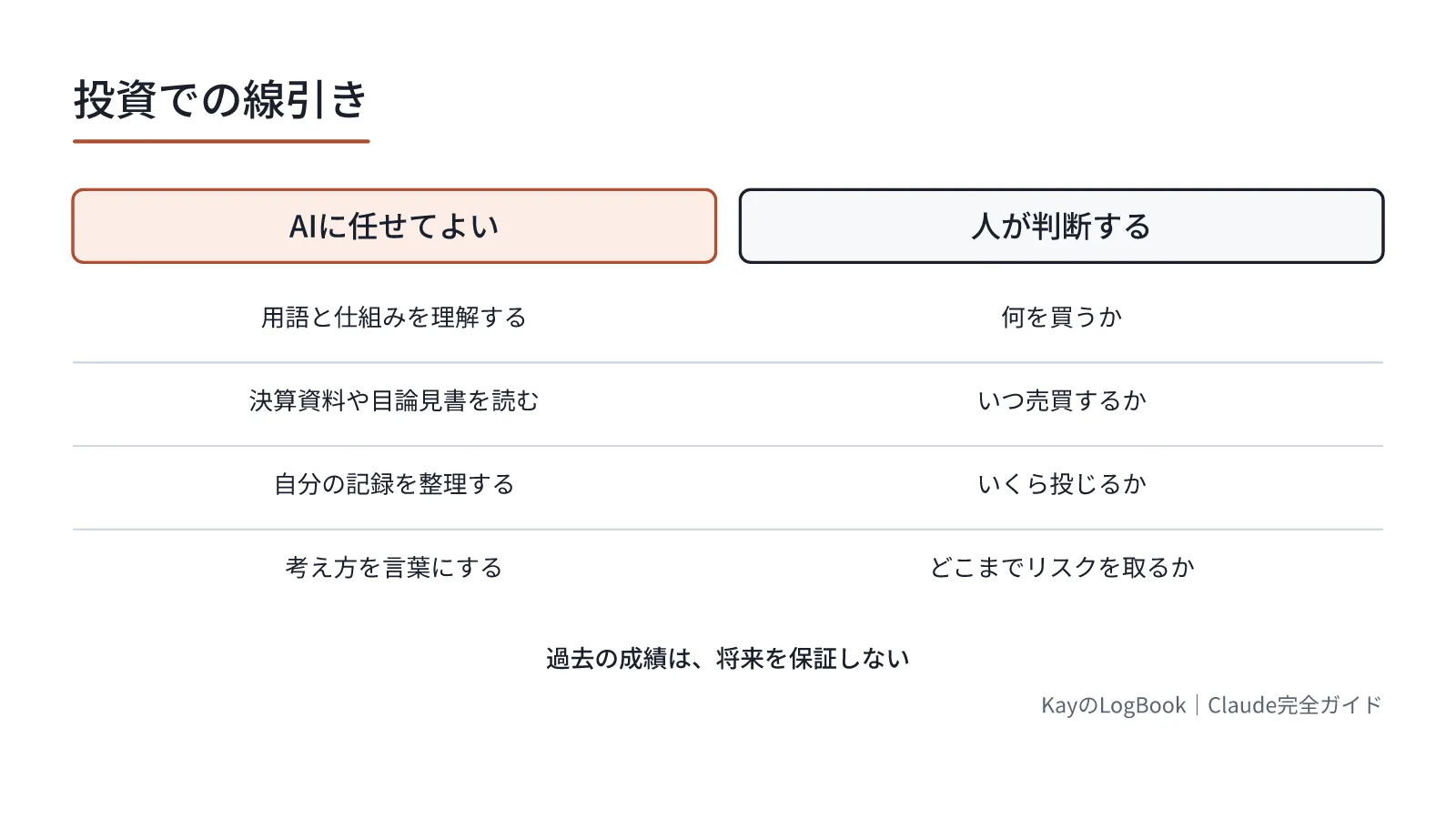
Don’t let it recommend stocks or judge when to buy or sell.
Use it for understanding terms and mechanisms, reading documents, organizing your own records, and putting your thinking into words.
First, what this page does not cover#
This page does not cover the following.
- Recommendations on what to buy
- Judgments on when to buy or sell
- Judgments on how much to invest
- Judgments on how much risk to take
- Automating orders (outside the scope of this guide)
And, to say it again: good results on past data do not guarantee the future.
Where to draw the line#
Understanding terms and mechanisms#
This is the healthiest use. Investing has a high wall of jargon.
Tell me about "(term)."

- Explain how it works so someone with no background can follow
- Why this mechanism came about
- Three common misconceptions
- In what situations it works against you

Don't name specific products or stocks.
Always ask in what situations it works against you. That’s the part sellers’ explanations tend to leave out.
The approach from Chapter 8, No.64, explaining it yourself and having Claude grade you, works especially well in this field. It’s an area full of thinking you understand when you don’t.
Reading earnings reports and prospectuses#
This turns long, hard-to-read documents into something you can read.
Tell me about this document.

- What the document is explaining
- The 5 most important figures in it and what they mean
- The items listed as risks
- Conditions that are hard to spot or buried in the notes

- Use only figures written in the document
- Don't judge whether it's good or bad, and don't make investment recommendations
The fourth point is the one that pays off. Footnotes and fine print are exactly what people skip.
Make it explicit that it shouldn’t judge. Otherwise, evaluations like “this looks undervalued” come along with it.
Organizing your own records#
Organizing your own trading records is both effective and safe.
These are my trading records. Produce the following.

- In chronological order, when I did what
- The reason I wrote down at the time (if there are notes) and the outcome
- Places where my decisions were inconsistent
- Calculate with code. Don't total things by eye

Don't evaluate whether anything was good or bad. Just organize the facts.
Having it surface places where your decisions were inconsistent is the heart of this approach. Being confronted with your own records works better than any advice.
Put your thinking into words and test it yourself#
The “sounding board” from Chapter 2, No.12 works best of all in this field.
I believe that "(your view)."

- List three weak points in this view
- I don't need arguments in favor
- In what situations would this view stop holding?
- If I wanted to check, what should I look at?

Don't recommend or reject it. Just examine it.
Don’t hand over the decision itself; have it examine your decision. Responsibility stays where it is, so this works even in this field.
If you want to test something technically with data, Chapter 6, No.49 has the steps. But there too, I wrote that if you pick a convenient period, most hypotheses will look like they hold.
Watch where information comes from#
Investing is a field where information is often written by people with a stake in it.
If you have Claude search, always open the sources (No.18). Who wrote it, and what are they selling?
And Claude makes mistakes too. Figures, company names, regulations. In this field, errors translate directly into money. Confirm with primary sources.
Before you share anything#
Trading records and asset information are financial documents. The caution in Chapter 4, No.27 applies as-is. Trim them down to only the columns you need before sharing (No.78).
Try it: Have it examine your thinking (5 minutes)
Pick one view you currently hold. It doesn’t have to be about investing.
Prompt
“`
I believe that “(your view).”
- List three weak points in this view
- I don’t need arguments in favor
- In what situations would this view stop holding?
- If I wanted to check, what should I look at?
Don’t recommend or reject it. Just examine it.
“`Expected result: Three weak points and “what would need to be true for you to change your mind.” No recommendation or rejection.
If it doesn’t work: If it starts by agreeing, the instruction got buried. Move “Write only counterarguments” to the first line.
Common pitfalls#
Asking for recommendations. That’s outside the scope of this page.
Having it evaluate. If words like “undervalued” or “promising” appear, the instruction isn’t taking hold.
Treating past performance as grounds for the future. It guarantees nothing.
Not recognizing sources with a stake. Open the sources.
Related pages#
- No.49 Hands-on: Connecting Market Data and Charts — Testing with data
- No.68 Organizing Household Finances — Where household finances end
- No.80 Living With Mistakes — How to verify
Summary#
- No recommendations and no buy/sell timing. Automating orders is out of scope
- What it’s good for: understanding terms, reading documents, organizing records, examining your thinking
- Have it surface places where your decisions were inconsistent from your own records
- Past performance does not guarantee the future