What Is an Agent?
On this page7 items
In 10 seconds
An agent takes instructions, makes a plan, uses tools to carry out the work, and checks the results itself.
The scope of what you hand over is different from getting an answer in a single exchange.
Up through Chapter 2, Claude was an “ask and it answers” tool. From here, its nature changes.
Take the quotation example. In Chapter 2, you handed over PDFs one at a time and pasted the returned tables yourself. Used as an agent, you hand over the folder, say “put these in a table,” and you’re done. Claude decides the steps in between and carries them out on its own.
It’s convenient, but you aren’t watching what happens within the scope you handed over. That’s the theme of Chapter 3.
What’s different#
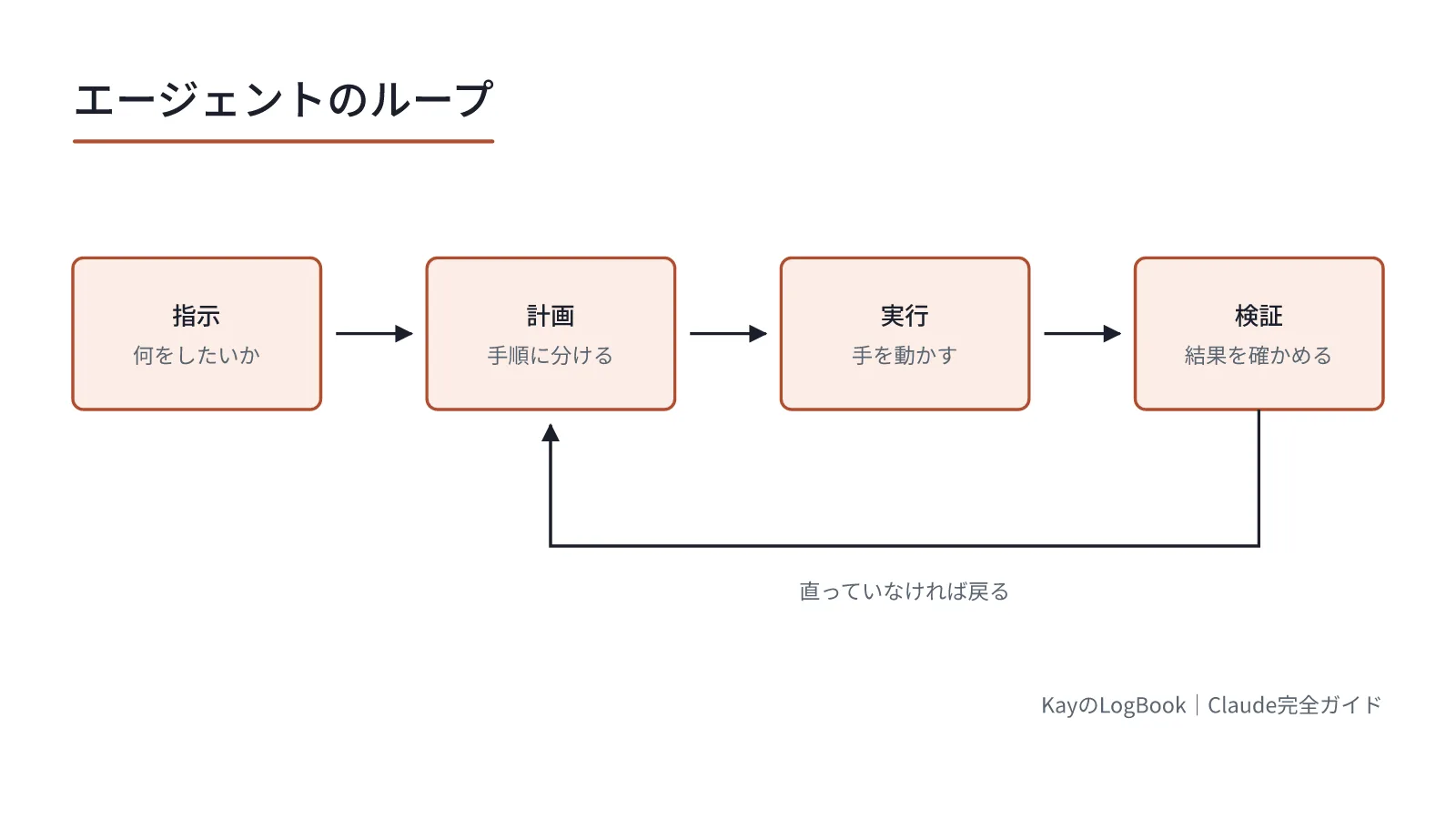
A normal exchange is a single round trip: instruction → answer. An agent inserts a plan → execute → verify loop in between.
Plan. It breaks the work into steps: “Open the PDFs from the five companies,” “Extract the items,” “Put them in a table,” “Check that the totals match.”
Execute. It uses tools to actually do the work. These “tools” are the subject of No.20.
Verify. It checks the results of its own work. Whether this step exists is the biggest difference. It doesn’t stop at making the table; it checks that the row count and the numbers match, and if they don’t, it goes back.
What becomes possible#
It can handle work whose steps aren’t decided in advance.
Suppose that among the five companies’ PDFs, just one has a different format. A program that only executes fixed steps would stop there. An agent notices on the spot and tries a different approach.
The other thing is volume. Work you used to hand over one page at a time can now be handed over a folder at a time. Twenty companies take the same effort.
When not to use one#
This is the core of the matter. The convenience and the danger come from the same property.
Work where mistakes can’t be undone. Bulk-deleting files, sending email, making payments, deploying to production. For irreversible operations, have a person press the final button.
Work that demands 100% accuracy. Even with a verification mechanism, you won’t reach 100%. Finalizing amounts, submitting legal documents, medical decisions. The agent handles the prep work only.
Situations where the judgment itself is the core of the work. Which supplier to choose isn’t decided by price alone. If you tell an agent “pick the cheaper one,” you get a conclusion that only looks at price. It’s suited to gathering the material for the decision.
Running it without being able to trace what happened. This is the scariest one. The agent runs 20 times: 19 times correctly, and once it quietly gets it wrong. If you have no way to notice, you shouldn’t hand it over in the first place.
Three things to decide before handing it over#
- Where it should stop (“Show me the table once it’s done. Don’t save it.”)
- What counts as success (“The row count must match the number of PDFs.”)
- What to do if it fails (“If there’s a PDF you can’t read, stop there and report it.”)
If you hand work over without these three, Claude decides them on its own. Without any ill intent, it fills them in with plausible judgments. The same thing No.11 described, “if you don’t specify how to handle exceptions, it fills them in with guesses,” happens on a larger scale.
Try it: have it judge whether a task can be handed over (3 min)
Prompt
“`
Please judge whether the following tasks can be handed to an AI agent.
Sort them into three groups, “OK to hand over,” “prep work only,” and “should not hand over,“
and give your reasons. Also tell me what point decided each one.
- (Write 3 to 5 of your own tasks)
“`Expected result: The tasks come back sorted into three levels. “Can it be undone?” and “Would a mistake be noticed?” come up as the deciding points.
If it doesn’t work: If everything comes back as “OK to hand over,” your task descriptions are too abstract. Write down “who receives what,” and the difference between recoverable and unrecoverable will show.
Common pitfalls#
Mistaking autonomy for intelligence. Being able to decide the steps on its own is different from its judgment being correct. The more freedom it has to decide the steps, the wider the range of mistakes it can make.
Feeling like you’ve checked when you haven’t. Nobody reads through every intermediate step. That’s exactly why you should design it so a person does the final verification.
Handing over a lot from the start. Check with one PDF, then expand to five companies. Skip this order and your mistakes come out multiplied by five.
Summary#
- An agent runs a plan, execute, verify loop on its own
- The decisive difference is that verification exists. It’s strong at work whose steps aren’t fixed
- Don’t hand over irreversible operations or work that needs 100% accuracy
- Before handing it over, give it the stopping condition, the success condition, and what to do on failure