Prep Work for Contracts and Legal Matters
On this page11 items
In 10 seconds
Claude is useful only for the prep work: reading, spotting issues, organizing questions, and drafting internal documents.
Don’t let the AI cite article numbers, case law or the names of statutes. Nonexistent ones get mixed in.
First, what this page does not cover#
This page covers only the prep work.
- It does not cover deciding whether to sign a contract
- It does not cover assessing legal risk
- It does not cover interpreting legal provisions
Leave the final judgment to experts such as lawyers. The techniques on this page are for speeding up your preparation before you consult them.
Where to draw the line#
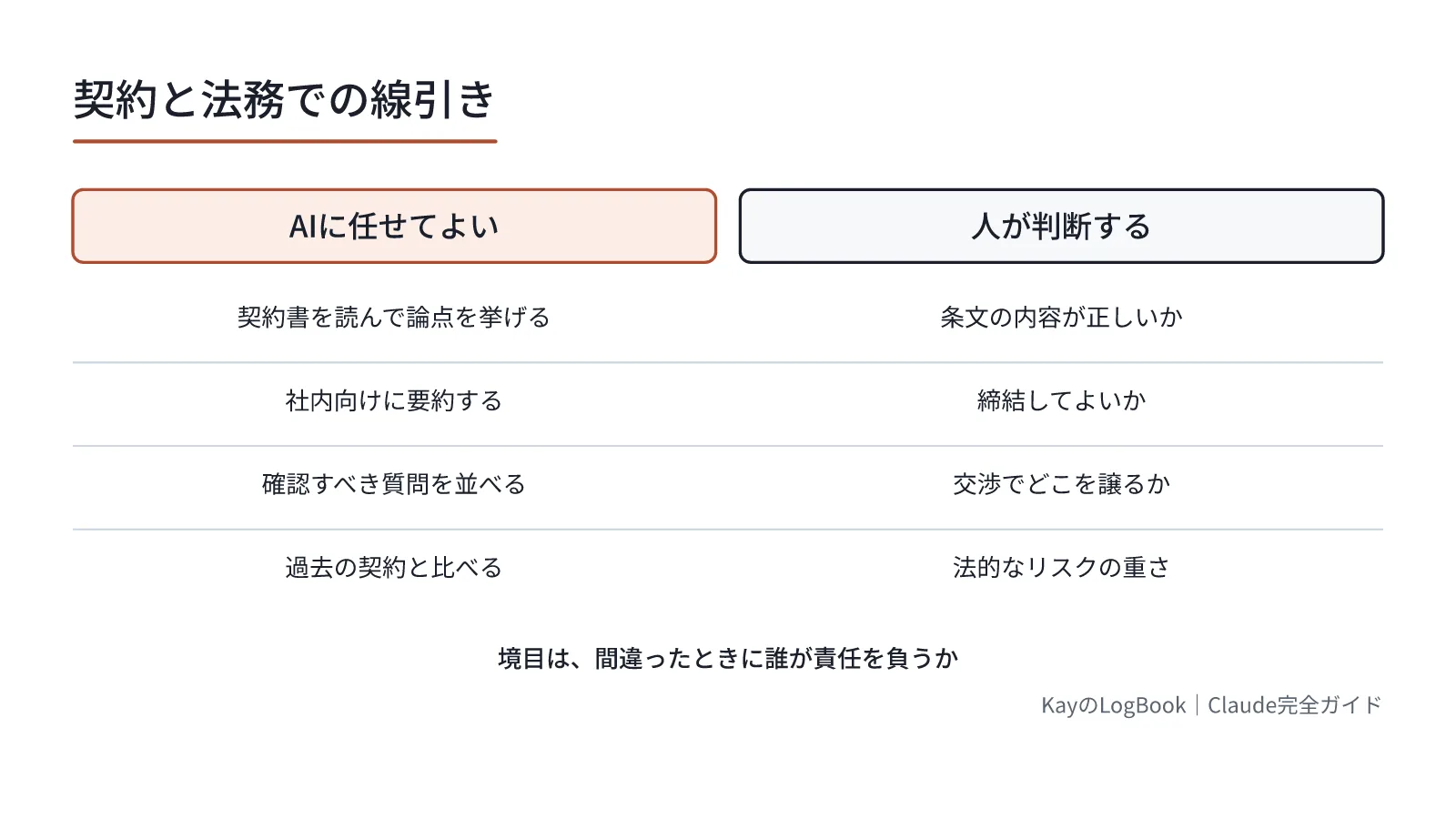
What you can hand off:
- Reading a contract and listing the issues
- Summarizing it for internal use
- Listing questions that need to be checked
- Comparing it with similar past contracts
What a person decides:
- Whether the content of the provisions is correct
- Whether to sign
- Where to give ground in negotiations
- How serious the legal risks are
Don’t let it cite article numbers#
This is the most important warning on this page.
As explained in No.02 in Chapter 1, Claude chooses “plausible words.” Statute-like style, statute-like phrasing, statute-like numbers. It all looks convincing, but it may not actually exist.
Names of laws, article numbers, and case law. These three are the classic places where plausible falsehoods slip in.
So ask like this:
Please tell me the following about this contract.

- Our obligations
- The other party's obligations
- The term, renewal and termination conditions
- Ambiguous wording that could be interpreted in different ways

**Do not cite names of laws or article numbers**.
For the relevant parts, quote the original text of the contract verbatim.
If you have it quote the original, you can verify it yourself. You can’t verify a summarized provision.
When checking the law itself, open a primary source such as e-Gov Law Search (Japan’s official legal database). Don’t simply trust what Claude told you.
Spotting the issues#
This is the most practical use.
Read this contract and list the points to check before signing.

- Up to 10, in order of importance
- One line each on "why this needs checking"
- Where in the contract to look, with a quote from the original
- Mark any parts that could work against us

Do not write article numbers or names of laws.
What people tend to miss isn’t the favorable clauses, but what isn’t written at all. Ask a follow-up like this and those come out:
List items that are not written in this contract but are usually specified.Preparing before you ask an expert#
Your time with a lawyer is limited. If you organize your questions before you go, you get much more out of the same amount of time.
I'm going to consult a lawyer about this contract.
Please organize the questions I should ask, in order of priority.

- Separate the things I could find out myself from the things I should ask an expert
- Include the underlying facts with each question
- Also list, as bullet points, the background I should explain
The first split is what makes the difference. Asking about things you could look up yourself is a waste of your time.
Drafting internal documents#
Internal regulations, terms of service, templates for outsourcing agreements. Claude can produce drafts.
But follow two rules.
Don’t use a template as is. The clauses you need vary by industry, size and type of transaction. Always have an expert review it.
Check the basis. If an explanation comes with “this is required by law,” verify that it’s true against a primary source.
Think first about whether you can share it#
Contracts contain information about business partners, amounts and terms. Whether you can hand one over as is depends on the plan you use and your company’s rules.
As explained in No.27 in Chapter 4, the official safety guidance explicitly says not to grant access to financial documents. Check first (No.78).
Try it: organize the questions to ask an expert (5 min)
Pick one contract or set of terms you have on hand. Make sure it isn’t confidential.
Prompt
“`
I want to prepare before consulting an expert about this document.
- Things I could find out myself
- Things I should ask an expert
Split them into these two groups and list each as questions.
Do not write names of laws or article numbers. Quote the original text for the relevant parts.
“`Expected result: A question list split into two groups comes back. The “could find out myself” side is surprisingly long.
If it doesn’t work: If article numbers appear, that instruction isn’t taking effect. Tell it again not to cite numbers. There’s value in seeing this behavior for yourself.
Common pitfalls#
Trusting article numbers. Always verify them against a primary source.
Deciding based on the summary alone. Ask for quotes from the original.
Taking “this is what the law says” at face value. Check the basis.
Skipping the expert consultation. The purpose of this page is to speed up the consultation, not to skip it.
Related pages#
- No.58 Translation and Working with Other Countries — how to read contracts in English
- No.71 Procedures, Paperwork and Manuals — personal contract documents
- No.80 Working with Claude on the Assumption It Makes Mistakes — about nonexistent provisions
- No.78 Security and Privacy — what you can share
Summary#
- Claude is useful only for the prep work. Leave the judgment to experts
- Don’t let it cite article numbers, case law or names of statutes. Have it quote the original
- It shines at spotting issues and organizing questions
- Check the law against primary sources such as e-Gov Law Search