What Are DLP and CASB? Preventing Data Leaks and Auditing SaaS
On this page11 items
The last page of Chapter 3 covers two features that protect the data itself: DLP and CASB. With the setup so far, people (Access), paths (Tunnel), and devices and traffic (WARP + Gateway) are now protected. But data leaks can happen even when the right person performs an action from the right device. Accidents like pasting a customer list into an external service, or creating a share link set to “anyone can view.”
DLP and CASB are defenses against these “leaks through legitimate actions.” The two are often discussed together, but they look at different places. This page sorts out how they divide the work and wraps up the chapter.
What you’ll learn on this page#
- What DLP (Data Loss Prevention) is and what it can detect
- What CASB (Cloud Access Security Broker) is and what it can check
- The distinction between “data in motion” and “data at rest”
- Where they fit in Cloudflare One and which plans include them
- A realistic sense of how far beginners need to go
What is DLP: checkpoints for data in motion#
Looking at the “contents” at the moment of sending#
DLP (Data Loss Prevention) inspects the contents of data sent out from a device and logs or blocks it if it contains sensitive information. It runs on top of the HTTP filtering (TLS inspection) covered two pages ago on Gateway. In other words, while Gateway looks at “where traffic is going,” DLP looks at “what someone is trying to take out.”
There are three main ways it detects data.
- Predefined profiles: Cloudflare provides patterns for common sensitive data such as credit card numbers, bank accounts, national identification numbers for various countries, credentials (passwords and API keys) and source code. Just select and enable them
- Custom detection: You can define patterns specific to your organization (the format of employee numbers, confidential document numbers and so on) with regular expressions
- Advanced matching (for Enterprise): More precise methods that reduce false positives are also available, such as matching against “your actual customer data itself” (Exact Data Match)
It applies to sending over the web in general: file uploads, form submissions, pasting into chats and more. One use that has become important in recent years is inspecting data sent to generative AI. A control like “block pasting customer information into an AI chat” is a typical new use of DLP (it also integrates with Cloudflare’s AI Gateway, covered in Chapter 7).
What is CASB: inspecting data at rest#
“Patrolling” inside your SaaS apps#
CASB (Cloud Access Security Broker, pronounced “cas-bee”) connects to SaaS apps such as Google Workspace and Microsoft 365 via their APIs and periodically scans the data and settings stored in them. Unlike DLP, which looks at the moment traffic passes, it patrols what’s already inside the SaaS.
Cloudflare’s CASB connects to the target SaaS with read-only permissions and, after the initial scan, automatically rescans roughly every 1 to 24 hours (depending on the service). It finds problems like these.
- Risky sharing settings: Sensitive files set to “anyone with the link can view,” folders shared with external domains
- Exposed credentials: API keys and passwords accidentally committed to GitHub repositories
- Misconfigurations: Admin accounts without multi-factor authentication, lingering accounts of people who have left, risky third-party integrations
Supported SaaS apps include the major ones: Google Workspace, Microsoft 365, Slack, GitHub, Salesforce and more. Detection results are listed as “Findings” with severity levels, and administrators deal with them. CASB never changes settings on its own.
How the two divide the work#
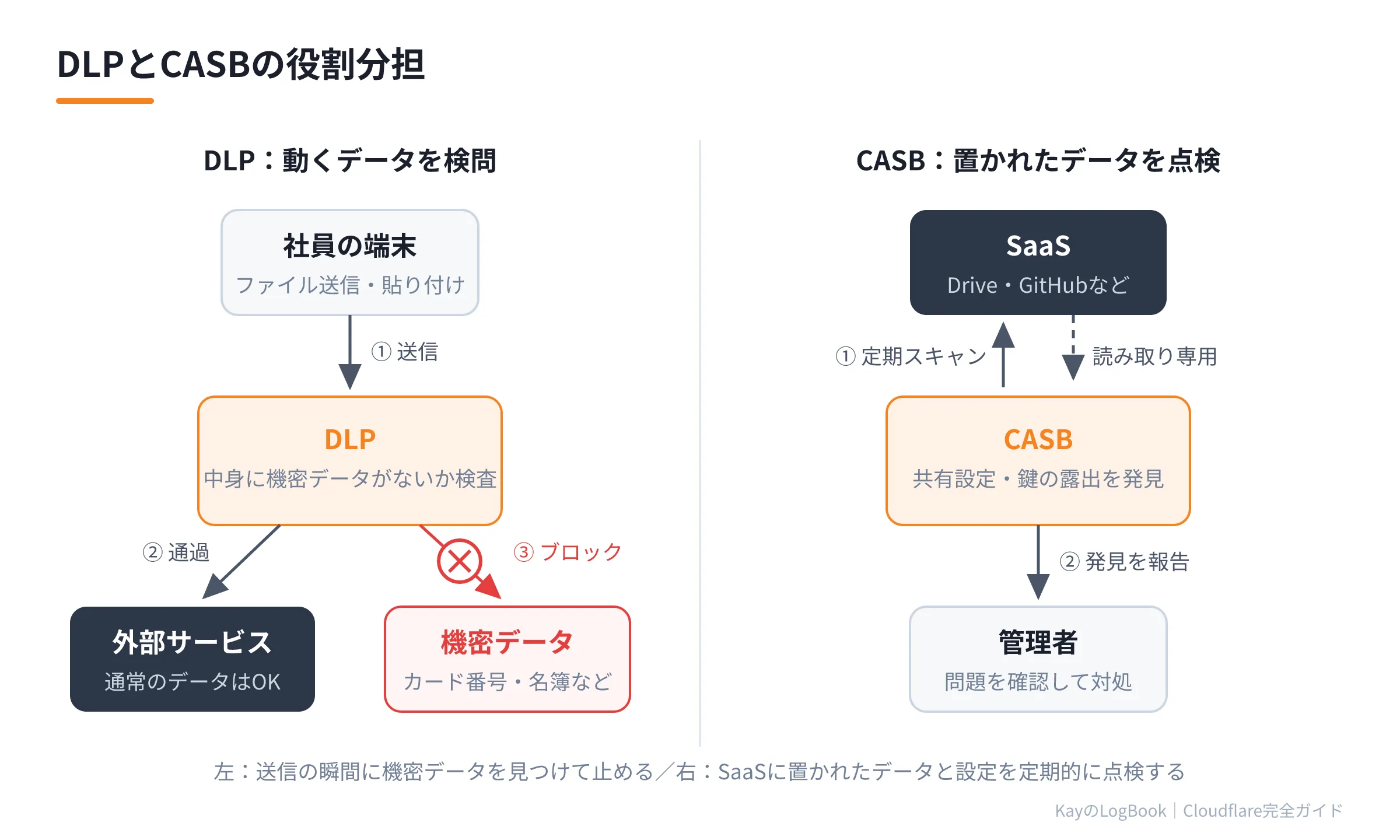
In security terminology, data being transferred is called data in motion, and stored data is called data at rest. DLP is a checkpoint for data in motion; CASB is an inspection of data at rest. Remembering them by this contrast is the most reliable way. The two also work together: when CASB scans files inside a SaaS app, it can use DLP profiles (credit card numbers and so on) to judge their contents.
Which plans include them#
Unlike the other features covered in this chapter, DLP and CASB are mainly full-featured under Enterprise (Contract) agreements (as of August 2026).
- Free / Pay-as-you-go: Limited use of DLP with some profiles, such as financial information. Enough to try out how it works
- Enterprise + add-on contracts: Full DLP profiles, Exact Data Match, full use of CASB and more
For individuals and small teams, a realistic stance is “use Access and Gateway regularly, and DLP and CASB when you need them.” On the other hand, if a company handles customer or personal information, these two are the heart of what to evaluate.
Points for beginners to watch#
- DLP only finds what you define: Deciding “what counts as sensitive data” is a human job. If profile selection and the definition of your own data stay vague, detection won’t work
- DLP requires TLS inspection: Since it looks at the contents of traffic, you first need to distribute the root certificate as explained on the Gateway page
- CASB is a read-only inspector: Fixing the problems it finds is the administrator’s job. Understand it not as “install it and you’re safe” but as a feature that “makes problems visible”
- Pair it with operational rules: Inspecting what employees send requires consideration for privacy. As mentioned in the Gateway section, documenting and communicating what is inspected is a prerequisite for rollout
- The first step is an inventory: Which SaaS apps do you use, and where is your sensitive data? You can’t configure DLP or CASB without knowing this. It’s the same idea as “build a register of what you’re protecting” from the API Security page
Related services#
- Cloudflare Gateway: The platform DLP runs on (HTTP filtering, TLS inspection)
- Cloudflare Access: The gatekeeper that controls logins to SaaS apps themselves. Complements CASB’s inspections
- AI Gateway: Manages traffic for AI apps. Combined with DLP, it prevents sensitive data from leaking to AI (Chapter 7)
- API Security: Its approach to API key management and visibility is closely related to CASB’s discovery features (Chapter 2)
Summary#
- DLP is a checkpoint for “data in motion.” It inspects what’s being sent and detects or blocks sensitive data such as credit card numbers from leaving
- CASB is an inspection of “data at rest.” It connects to SaaS apps via API and finds risky sharing, exposed credentials and misconfigurations through periodic scans
- The two work together; CASB scans use DLP detection profiles
- Full features are mainly for Enterprise. The free tier lets you try it out with some profiles
- Before the technology, you need to define and inventory “what is sensitive and where it is”
That completes Chapter 3, “Zero Trust.” Starting from the limits of perimeter defense, we’ve gone through the full set of Zero Trust components: the map of Cloudflare One, authentication (Access), paths (Tunnel), egress inspection (Gateway), devices (WARP), and data (DLP and CASB). The next chapter shifts the focus to the network foundation and surveys services for corporate networks.